Drawstring bag
Make a simple flat drawstring bag while practising seam allowance, edge finishing and a folded casing.
Beginner
Straight seams · casing
1/2 in unless stated
Prewash as appropriate
Cutting plan
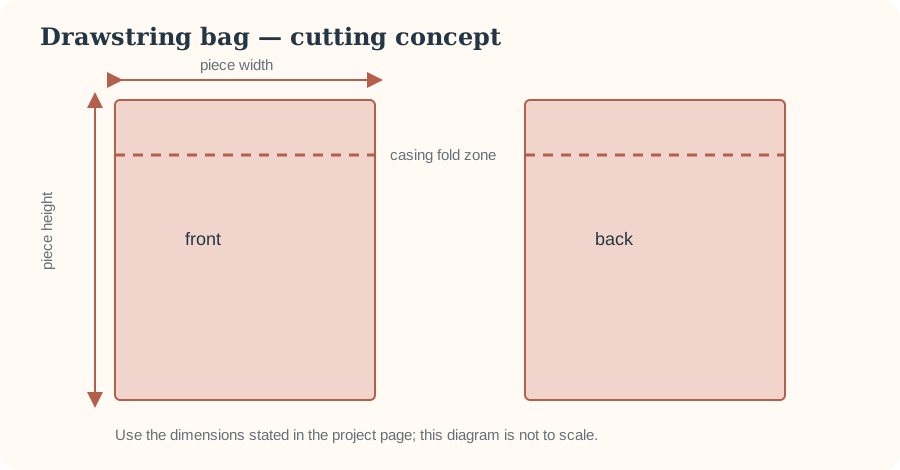
Cut two rectangles 10 × 14 in. With 1/2 in side/bottom seams and a 1.5 in double-fold-style top casing treatment described below, the finished bag will be smaller than the cut pieces; exact height depends on how the casing is formed.
10 × 14 in
2 lengths, test fit before trimming
1. Finish the raw side edges
If your fabric frays, finish the long side edges before forming the casing, using a method suitable for the fabric and your equipment.
2. Mark the casing zone
At the top of each piece, press 1/2 in to the wrong side and then 1 in again. Unfold temporarily. This creates a clean top edge and a 1 in casing when stitched.
3. Sew sides and bottom
Place pieces right sides together. Sew the bottom and sides with a 1/2 in seam allowance, stopping below the casing opening area so the drawcord can enter. Reinforce the stopping points.
4. Sew the casing and thread the cord
Refold the pressed top casing and stitch close to its lower folded edge. Turn and press the bag. Feed cords through the casing openings, testing operation before tying or trimming.
Before cutting valuable fabric
- Confirm the measurements suit your intended use.
- Account for directional prints, nap and shrinkage.
- Test needle, thread, stitch length and seam allowance on scraps.
- Read the complete construction sequence once before starting.
Beginner construction notes
A drawstring bag is useful practice because it combines straight seams, edge finishing, pressing and a casing without requiring precise garment fit. Before cutting, confirm the project's stated finished dimensions against the cutting dimensions and seam/casing allowances shown in the construction map.
Fabric and cord choice
Use a stable woven fabric for the easiest first version. Very bulky fabric makes a small casing difficult to turn and thread; very slippery fabric adds handling difficulty. Choose cord or ribbon that moves freely through the planned casing without being so thin that it cuts into the fabric.
Prepare before sewing the side seams
Mark the casing fold lines and any opening points while the fabric is flat. Finish raw edges as the instructions require before enclosing areas that will become difficult to reach. Pressing the casing folds in advance makes the final top edge more predictable.
Keep the casing clear
When sewing the side seams, do not accidentally close the intended cord channel. Backstitch where the construction sequence requires reinforcement and check that both openings remain usable before turning the bag right side out.
Thread and test
A safety pin, bodkin or suitable threading tool can guide cord through the casing. After threading, pull the bag closed several times before knotting or finishing the cord ends. Watch for excessive friction, twisted casing or stitches catching the cord.
Quality checkpoint
The bag should lie flat without a twisted side seam, the casing should be an even depth, and the cord should slide without forcing it. If the first version reveals a dimensional issue, update the paper measurements before cutting another rather than “correcting” every subsequent bag by eye.
Finished this project and ready for a garment pattern?
If you want to progress from this free project to a downloadable garment pattern, Winslet’s offers a collection aimed at beginners. Sewing Skillbook has not independently tested its patterns, so check the current sizing, fabric requirements and skill level before choosing one.
Reader discount: Use code SEWINGSKILLBOOK for 10% off at Winslet’s. The discount is provided by Winslet’s and may be subject to its current terms.