Seam allowance explained
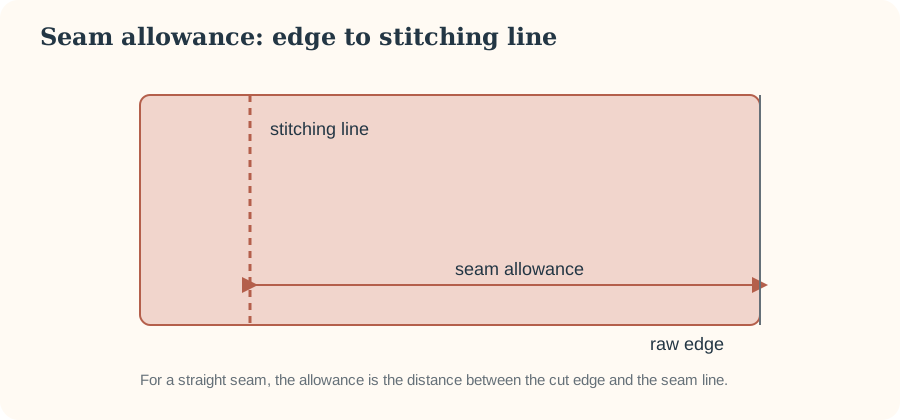
Seam allowance is the fabric between the stitching line and the raw edge. It is not the same thing as the finished seam width.
Follow the pattern first
Commercial and independent patterns may use different seam allowances, and some patterns exclude them entirely. Read the instructions rather than assuming a familiar value.
How cutting dimensions change
If a flat rectangular piece needs seams on two opposite edges, add one seam allowance for each sewn edge. A 12-inch finished width with 1/2-inch seams on both sides needs a 13-inch cut width.
Curves and corners
Seam allowance is measured outward from the stitching line. Curved seams may need clipping or notching after sewing so the allowance can spread or compress when turned. Do not clip through the stitching.
Marking and consistency
Use the machine throat-plate guides only after confirming what they measure on your model. For precise work, a removable guide or marked line can make it easier to keep the raw edge at a constant distance.
Seam allowance controls finished size
Seam allowance is the material between the cut edge and the line of stitching. It is not “waste”: it gives the seam enough material to be joined, finished and sometimes adjusted. Sewing a different allowance from the one assumed by the pattern changes the finished dimensions.
Why small errors accumulate
Imagine two pieces joined with a seam that should use 5/8 inch on each side. If you consistently sew 1/8 inch farther inward than intended, the assembly becomes 1/4 inch smaller across that joined pair. Repeat the error across several seams and the fit can change noticeably. Consistency matters as much as the nominal number.
Do not assume every pattern uses 5/8 inch
Many traditional garment patterns use 5/8 inch, but modern and independent patterns may use 3/8 inch, 1/2 inch, 1/4 inch or different allowances for different operations. Some patterns exclude seam allowance entirely. Read the instructions and pattern markings before cutting or stitching.
Ways to sew an accurate allowance
Use the seam guides on the needle plate if they are clear and appropriate to the selected needle position. A removable guide or compatible seam-guide foot can help with repetition. Watch the fabric edge against the guide rather than staring only at the needle. On curves, slow down and keep the edge consistently related to the guide.
Curves, clipping and grading
After stitching, some curved seams need clipping or notching so the allowance can spread or compress when turned. Layered seams may be graded to reduce bulk. These are post-stitching operations; do not casually trim a seam allowance before you know how the construction step uses it.
Seam finishes need room
A French seam, flat-felled seam, overlocked edge or bound seam may require a particular allowance and sequence. If you plan to substitute a seam finish, verify that the available allowance supports it rather than assuming any finish fits any width.
Use the calculator for rectangular planning
For simple projects where a finished width or height needs seam allowance on two opposite edges, our calculator can add the allowance twice. It is not a substitute for a drafted garment pattern, shaped seam or construction method with special turnings.