Choosing fabric for a sewing pattern
The prettiest fabric is not always the easiest or most suitable fabric for a particular pattern.
Start with the recommended fabric list
Pattern designers choose recommendations because structure and drape affect the finished shape. A crisp tote and a flowing blouse ask very different things from fabric even if both could technically be stitched.
Woven versus knit
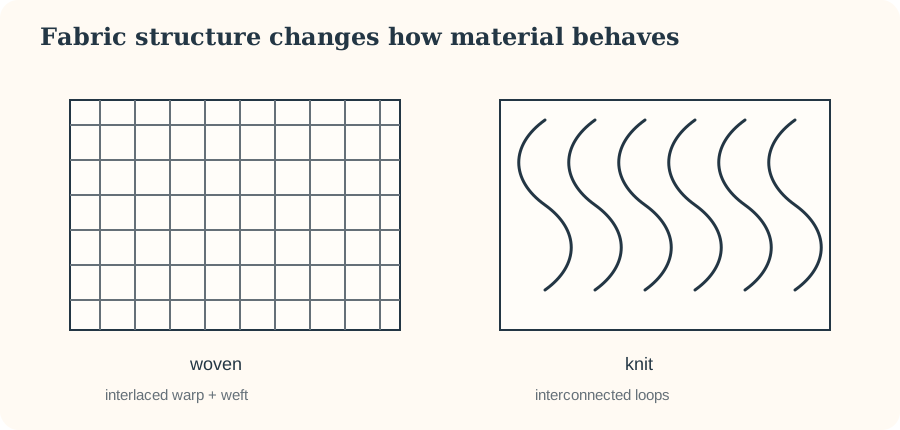
Wovens and knits behave differently, especially in stretch and edge stability. Do not substitute one for the other unless the pattern is designed to accommodate that change.
Weight and drape
Two fabrics of similar fibre content can behave very differently. Hold or drape a sample when possible and compare it with the silhouette the pattern is trying to create.
Prewashing and shrinkage
If the finished item will be laundered, prepare the fabric in a way appropriate to its fibre and the pattern guidance before cutting. Shrinkage after cutting can change fit and dimensions.
A practical fabric checklist before you buy
Start with the pattern or project rather than the print. Ask whether the finished item needs to hold a crisp shape, fall softly, stretch with the body, resist abrasion, or tolerate frequent washing. Those requirements narrow the field much faster than fibre name alone. Two cotton fabrics can behave very differently: a quilting cotton is relatively stable and crisp, while a cotton lawn is lighter and more fluid.
Weight, drape, stretch and stability
Weight describes how substantial the cloth is; drape describes how it hangs; stretch is how much it extends; and stability is how readily it shifts or distorts while cutting and sewing. For a first project, a stable light-to-medium woven is usually easier to mark, cut and feed than a slippery satin, loose weave or highly elastic knit. That does not make difficult fabrics “bad”—only less forgiving while you are learning several skills at once.
Read the pattern's suggested fabrics literally
If you are using a commercial pattern, treat its suggested-fabric list as design information. A pattern drafted for a fluid rayon can look and fit very differently in stiff canvas. A knit pattern may rely on stretch for dressing and movement, so substituting a non-stretch woven can make the garment impossible to wear. Check whether the pattern specifies a stretch percentage or a stretch test box.
Check width before calculating yardage
Fabric width changes how many pattern pieces fit across the cloth. Use the yardage row for the width you are actually buying rather than assuming all bolts are equivalent. Directional prints, nap, one-way designs and pattern matching can also increase consumption because pieces cannot simply be rotated to fill gaps.
Care and pre-treatment
Think about the finished item's care before cutting. If the fabric is likely to shrink and the finished project will be washed, pre-treat it in a way that reasonably resembles future laundering. Record unusual care instructions from the bolt or retailer. Press a test scrap using a suitable temperature before pressing the whole length.
Shop with a scrap-test mindset
When possible, keep a small offcut for testing needle type, stitch length, seam finish and pressing. The useful question is not “what setting is correct for cotton?” but “what combination gives a clean seam on this particular cotton, with this thread and this machine?” That habit makes fabric choice and machine setup much less mysterious.