Grainline and fabric direction
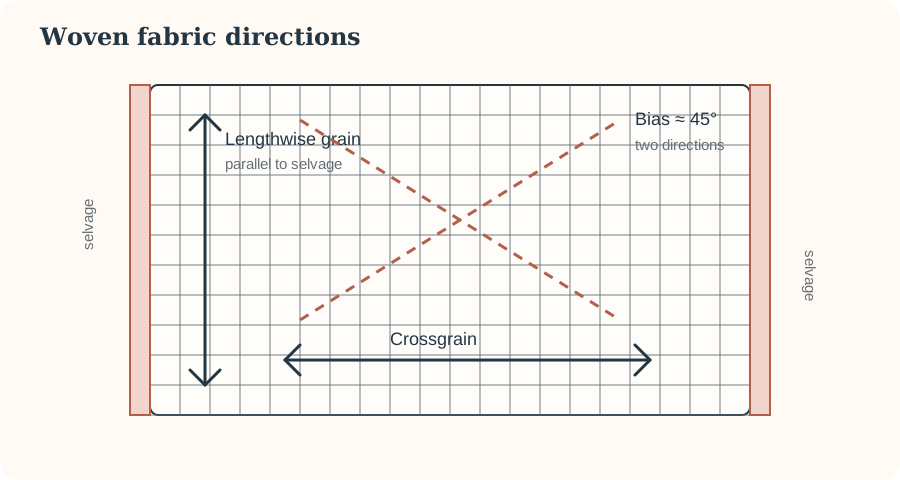
Grain direction affects how a woven fabric hangs, stretches and behaves, so pattern placement is functional rather than decorative.
Lengthwise and crosswise grain
Woven fabric has threads running lengthwise and crosswise. The selvage runs along the lengthwise direction. Many garment pattern grainlines are positioned parallel to that selvage.
Bias
The diagonal direction of a woven fabric generally has more give than straight grain. Bias can be useful deliberately, but accidentally cutting an intended straight-grain piece off-grain can change drape and stability.
Directional prints and nap
If motifs have an obvious top or a fabric changes appearance when brushed in opposite directions, pieces may need to face the same way. That can increase fabric requirements because pieces cannot simply be rotated for efficiency.
Check before cutting
Fabric can arrive skewed or distorted. Follow the pattern company’s preparation guidance and make sure your placement reflects the actual grain, not merely the cut edge from the shop.
Why grain direction changes the result
Woven fabric has lengthwise yarns running parallel to the selvage and crosswise yarns running across the width. The diagonal direction is the bias, which can behave more flexibly. Pattern pieces are drafted with a particular orientation so the finished item hangs, stretches and supports itself as intended.
How to place a grainline accurately
For a conventional straight-grain arrow, position the pattern piece roughly, pin or weight one end, then measure from the arrow to the selvage. Measure again at the other end. Adjust until the distances match, then secure the piece. Measuring to a straight selvage is generally more reliable than judging by eye.
What happens when a piece is off grain
A slightly crooked placement may introduce unwanted twisting, asymmetry or stretch, particularly in long garment pieces. The effect depends on fabric and design, but grainline is not merely a way to fit pieces efficiently on the cloth. Treat it as a construction instruction.
Crossgrain and bias are intentional when specified
Some designs deliberately place pieces on the crossgrain or bias to use different stretch or drape characteristics. Follow the printed arrow rather than “correcting” an unusual orientation. Bias-cut pieces deserve gentle handling because they can distort while hanging or sewing.
Directional prints and nap add another constraint
Even when grainlines are correct, a one-way print, velvet-like nap or directional surface may require every piece to face the same direction. This can increase fabric requirements because pieces cannot be turned end-for-end simply to save space.
Grainline on knits
Knits do not behave exactly like woven fabric, but patterns still provide orientation information and often specify the direction of greatest stretch. Respect both the grain/wale direction and the required stretch direction. If a knit garment relies on horizontal stretch and the fabric is rotated incorrectly, fit and recovery can change substantially.