How to calculate fabric stretch percentage
A fabric labelled “stretch” still may not suit a pattern. Stretch percentage tells you how far a measured section can comfortably extend relative to its relaxed length.
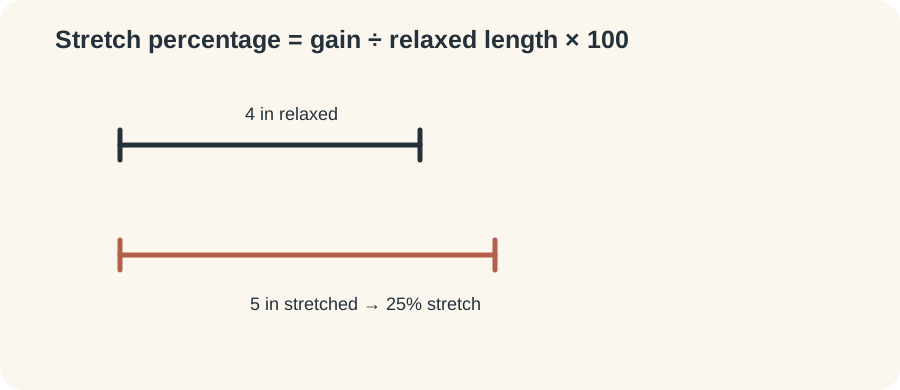
The basic calculation
Measure a section of fabric at rest without including a distorted cut edge. A 4-inch reference is convenient. Stretch it comfortably in the direction the pattern cares about without forcing it to its absolute limit. If 4 inches reaches 5 inches, it gained 1 inch: 1 ÷ 4 × 100 = 25% stretch.
Formula
Stretch percentage = (stretched length − relaxed length) ÷ relaxed length × 100. A 10 cm sample that comfortably reaches 12.5 cm also has 25% stretch. The units cancel as long as both measurements use the same unit.
Two-way vs four-way language can be confusing
Retailers do not always use “2-way” and “4-way” consistently. What matters for sewing is the actual direction and amount of stretch across the width and along the length. Test both directions and follow the pattern’s stretch requirement.
Recovery matters
After stretching, release the sample. Fabric that returns close to its original measurement has better recovery than fabric that remains elongated. A fitted garment can require both adequate stretch and recovery; percentage alone does not predict performance.
Do not substitute by number alone
Weight, opacity, drape, fibre, recovery and direction all matter. If a pattern includes a printed stretch gauge, use it because it directly expresses the designer’s requirement. Test before cutting a garment, especially when negative ease is involved.
Make the measurement repeatable
Use a section well away from the cut edge and selvage, because damaged edges can exaggerate stretch. Hold the sample at two clearly marked points and stretch until it feels comfortably extended, not until the fibres are being forced. Repeat the measurement a few times. If the results vary widely, the material may be difficult to assess or your pull is inconsistent.
For a pattern that requires at least 40% crosswise stretch, a fabric that only reaches 25% is not made suitable by choosing a larger garment size; the design may depend on stretch for movement, neckline expansion or negative ease. Conversely, much greater stretch with weak recovery can also change fit. Treat the pattern’s stretch requirement as a material specification, not merely a sizing suggestion.