Sewing machine needles: a beginner’s guide
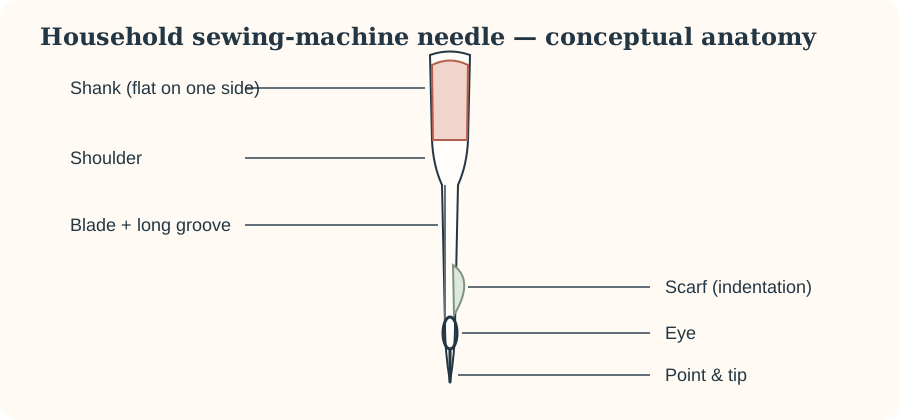
Needle choice gets easier when you separate two decisions: type for the fabric/application, and size for the material and thread.
What the two numbers mean
Home sewing machine needles are commonly labelled with two equivalent sizing systems, such as 80/12 or 90/14. As the number increases, the needle becomes larger.
Choose the type for the material
A Universal needle is a common starting point for many woven fabrics. Knits and highly elastic materials may call for needle types designed for those structures; dense denim commonly uses a Jeans/Denim needle. The exact recommendation depends on fabric, thread, application and machine compatibility.
Choose the size as a starting point—not a commandment
Fine fabrics generally start with a finer needle and heavier materials with a larger one. Always test the complete combination on a scrap because fabric density, thread and seam thickness matter.
When to change the needle
If stitching quality suddenly deteriorates, inspect the needle early in the troubleshooting process. A bent, blunt, damaged or incorrectly installed needle can contribute to skipped stitches and other problems.
A practical needle decision process
Choose in this order: first the needle type for the fabric structure/application, then the size for fabric weight and thread, then verify the result on a scrap. SCHMETZ lists Universal 70/10–90/14 for woven cotton, Jersey 70/10–100/16 for knits, Stretch 75/11 or 90/14 for many elastic knits, Jeans 90/14–110/18 for denim, and Microtex across fine-to-larger sizes for densely woven or precision work. Those are ranges, not promises that one size works for every fabric.
Universal versus Microtex on wovens
Universal is a sensible baseline for many ordinary woven fabrics. Microtex has a slim acute point intended for precision penetration and is commonly suggested for microfibres and a range of fine or densely woven materials. If an ordinary woven sews cleanly with Universal, there is no need to treat a specialty needle as automatically superior.
Jersey versus Stretch
Jersey/Ballpoint needles are commonly used for knitted structures, while Stretch needles are designed for highly elastic materials and are offered in different size ranges. “Knit” is therefore not a complete needle specification. Consider the fabric's elasticity, density and weight and use the fabric manufacturer's information when available.
Jeans needles and thick intersections
A Jeans/Denim needle is designed for dense woven materials, but a larger needle does not make a domestic machine unlimited. Thick seam intersections can still deflect the needle or prevent the presser foot feeding evenly. Slow down, keep the foot level using an appropriate technique, and stop if the machine binds or the needle strikes metal.
How thread changes the decision
The needle eye must accommodate the thread without excessive friction. A heavier thread may require a larger needle or a needle type with an appropriate eye, provided that size also suits the fabric. If thread shreds at the needle, inspect both the needle condition and the needle–thread size relationship before altering machine tension.
Signs the starting choice needs changing
Skipped stitches, fabric damage, audible punching, thread shredding or a seam that looks disproportionately perforated are reasons to stop and reassess. Change one variable at a time and keep the successful scrap. The selector on this site is deliberately a starting-point tool, not a replacement for the machine manual or a fabric test.
Try the selector
Research notes
This guide was developed from manufacturer education and support material, including SCHMETZ needle guidance and SINGER troubleshooting documentation. It is research-led guidance and does not claim hands-on testing.