Sewing machine needles by fabric
Needle choice is not a single universal chart: fabric construction, elasticity, density, weight and thread all matter. This reference summarizes practical starting territory and points you back to manufacturer guidance.
Stable woven cotton and linen
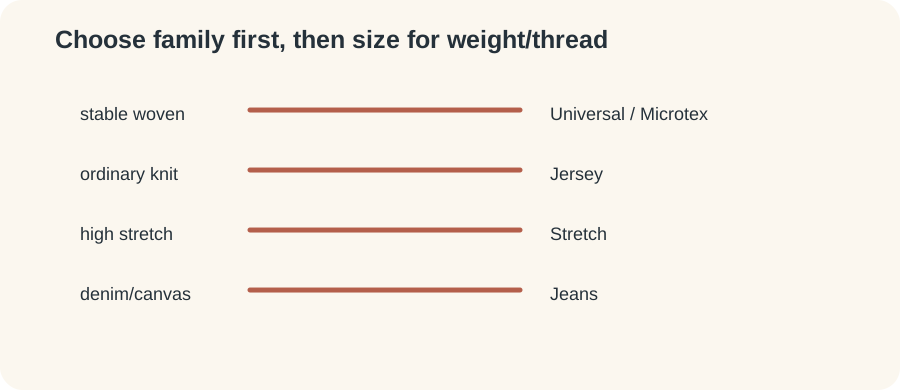
Universal needles are common starting choices for many ordinary wovens. SCHMETZ currently lists woven cotton and linen around 70/10–90/14. Very fine or densely woven material may benefit from a sharper Microtex point instead.
Jersey and ordinary knits
A Jersey/Ball Point needle is designed for many knitted structures. SCHMETZ lists cotton knit with Jersey 70/10–90/14 and general knits across a broader range. If the knit contains substantial elastic fibre, Stretch may be the better family.
Highly elastic fabrics
For Lycra/spandex-rich or highly elastic knits, SCHMETZ lists Stretch 75/11 and 90/14 in many relevant categories. That is why our starting-point selector does not invent a Stretch 80/12 merely to make every weight button different.
Denim and canvas
Dense/heavier fabrics often use Jeans/Denim needles. SCHMETZ lists denim around 90/14–110/18 on its current fabric page and canvas 90/14–110/18. Thickness and thread still determine where within the range to start.
Silk and fine dense wovens
Microtex is a useful sharp-point family for many fine or densely woven materials. SCHMETZ lists silk with Microtex 60/8–90/14 and chiffon/organza at the finer end. Fine needles also require appropriately fine thread and careful testing.
Fleece and specialty fabric
Fleece recommendations vary with construction: SCHMETZ lists Universal 70/10–90/14 or Stretch 75/11–90/14. Faux leather, vinyl and coated fabrics have different point/friction considerations. Consult a fabric-specific manufacturer recommendation rather than treating “heavy” as one category.
The selection routine
Choose needle family from fabric structure/application, then size from fabric weight/thread. Install a fresh needle, test the actual seam stack, inspect holes and stitch formation, and move one step if the result suggests the needle is too fine or too heavy.
Signs the starting needle needs changing
A needle that is too heavy can leave visible holes or damage delicate fabric; one that is too fine for the thread/layers can flex, break or produce poor stitch formation. Skipped stitches can indicate the wrong needle family, damage or installation as well as size. Thread shredding can point to a needle/thread mismatch or burr. Diagnose the whole combination rather than moving randomly through sizes.
For layered projects, choose for the seam you actually need to penetrate. A medium cotton plus several folded seam allowances is not the same challenge as a single layer. Make a scrap stack that reproduces the thickest normal intersection. If the machine cannot handle the stack safely with an appropriate needle, do not solve the problem by fitting an ever-larger needle beyond the machine/material guidance.