Fabric selvage explained
On woven fabric, the selvages are the finished lengthwise edges created during manufacture. They are a valuable orientation clue, but they are not usually part of the finished garment pieces.
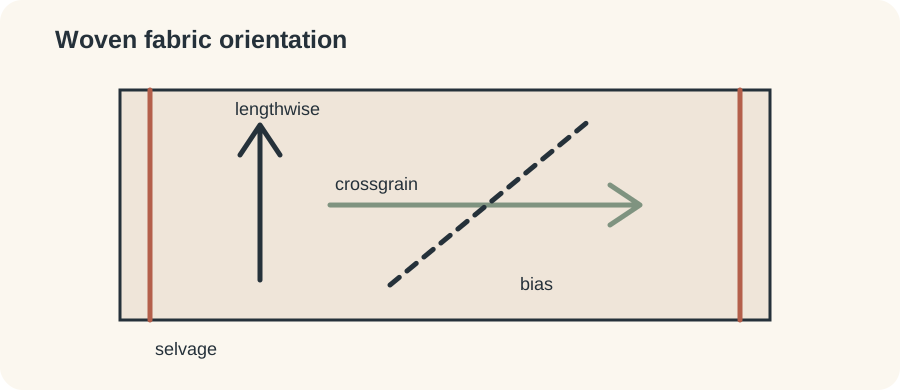
Selvage and lengthwise grain
The lengthwise grain runs parallel to the selvages. Pattern grainline arrows are commonly aligned parallel to this direction. Measuring from both ends of a long grainline arrow to the same selvage is a practical way to check that the piece is not skewed.
Why you usually do not include selvage
Selvages can be tighter, differently finished, printed with identification marks or otherwise behave differently from the main cloth. Unless a pattern or design intentionally uses them, keep pattern pieces inside the usable fabric width.
Crossgrain and bias
Crossgrain runs from selvage to selvage. True bias sits about 45 degrees to the lengthwise and crosswise grain and usually has more mechanical give in a woven fabric. That is why grain orientation affects drape and stability even when two pieces have identical shapes.
Is a selvage always obvious?
Not always. Some fabrics have subtle edges, and knits are constructed differently from conventional wovens. If you cannot confidently identify orientation, use the fabric description, stretch direction, visible structure and pattern instructions rather than guessing.
A useful layout check
Before pinning or weighting every pattern piece, confirm the fold and selvages match the cutting layout. Then check grainline arrows individually. This small step prevents an entire cutting session from being based on a rotated or skewed layout.
Selvage mistakes that affect cutting
Do not assume a fold is on-grain merely because the selvages touch. Fabric can be skewed, and printed motifs may not be perfectly aligned with the woven grain. Smooth the cloth without twisting it and check that the fold lies naturally. If a pattern uses a single-layer layout, keep the grainline measurement consistent even without a fold.
When estimating fabric requirements, remember that the printed or tightly woven selvage may reduce usable width. A fabric sold as 45 inches wide does not necessarily provide 45 inches of identical usable face. This matters for wide pattern pieces and is one reason the fabric planner on this site asks for usable width rather than relying on the nominal bolt width.