Why is my sewing machine skipping stitches?
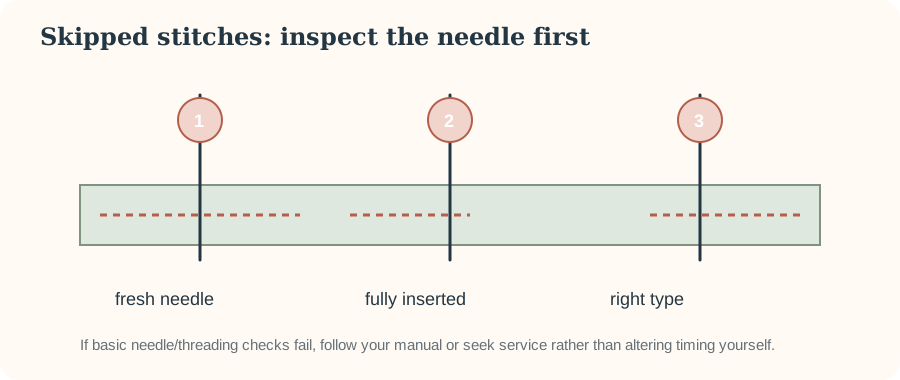
Skipped stitches often point to the needle/thread/fabric combination or needle installation before they point to an internal machine fault.
1. Replace and reinstall the needle
Fit a fresh needle of an appropriate type and size. Push it fully into the clamp and orient the flat side exactly as your manual specifies. A bent, blunt or incorrectly inserted needle can prevent reliable stitch formation.
2. Rethread the machine
Raise the presser foot and rethread the upper path from the beginning. Confirm the take-up lever and final needle guide are threaded. Reinsert the bobbin according to the manual.
3. Match the needle to the fabric
Knits, stretch fabrics and dense materials can need different needle designs. If ordinary woven cotton sews cleanly but the project fabric skips, the fabric/needle combination is a useful clue.
4. Know when to stop
If a correct fresh needle, correct threading and suitable settings still skip consistently across ordinary test fabric, the machine may need professional inspection. Timing is not a beginner adjustment to make casually.
Start with the needle because it is easy to eliminate
A skipped stitch is a gap where the machine failed to form a normal stitch. SINGER's troubleshooting guidance identifies damaged, dull, incorrectly inserted or unsuitable needles as common checks, particularly when sewing knits or synthetics.
1. Replace the needle rather than merely looking at it
A needle can be subtly bent or worn without looking dramatic. Install a fresh needle of the correct household system, push it fully into the clamp in the orientation required by your manual, and tighten securely with the machine switched off.
2. Match needle type to the fabric
Stable woven cotton may work with a Universal needle, while many knits are better served by Jersey/Ballpoint or Stretch types depending on elasticity and construction. SCHMETZ publishes fabric-specific ranges rather than one universal answer. Choose size according to fabric weight/thread and test.
3. Rethread completely
Raise the presser foot and rethread the upper path, including the take-up lever. Check bobbin type, winding and insertion. A thread-path error can coexist with skipped stitches, so restoring a known setup prevents you from diagnosing several variables at once.
4. Reproduce the problem on a controlled scrap
Use the same fabric and layers. Sew slowly without pulling the material. If skips happen only over a bulky seam intersection, the needle may be deflecting as the foot climbs the thickness; use the construction technique recommended for that project rather than forcing the fabric.
5. Consider service only after basic variables are ruled out
Hook timing and other internal faults can cause skipped stitches, but they are not sensible first adjustments for a beginner. If multiple suitable fresh needles, correct threading and ordinary settings all fail on normal fabric, consult the manufacturer's troubleshooting information or a technician.