Seam finishes for beginners
A seam finish manages raw edges inside a project. The best choice depends on fraying, bulk, appearance, washability, equipment and what the pattern expects.
Why finish a seam
Many woven fabrics shed threads from a cut edge during handling and laundering. Finishing can reduce that fraying and make the inside easier to live with. Some fabrics barely fray; some projects enclose the raw edge completely; knits often behave differently. Do not add a finish blindly if it creates unnecessary bulk.
Zigzag finish
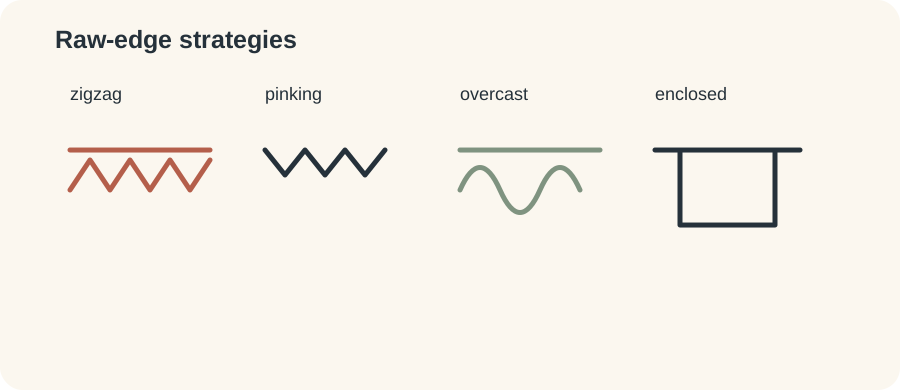
A regular sewing machine can zigzag close to the raw edge. Test width and length so the fabric remains flat rather than tunnelling. This is accessible and works on many everyday wovens, though the result is less enclosed than a French seam or binding.
Pinking
Pinking shears cut a saw-tooth edge. They can reduce fraying on suitable tightly woven fabrics and are fast, but they do not lock the edge with thread. Test a scrap and consider how often the item will be washed.
Overcast or overedge stitch
Many machines include an overcasting stitch, sometimes used with a dedicated overcasting foot. The exact stitch and foot are machine-specific, so consult the manual. It can create a more controlled edge than a basic zigzag without requiring a serger.
French and enclosed seams
A French seam encloses raw edges within a second seam and can be attractive on suitable lightweight fabrics. Bound seams cover an edge with binding. These methods are useful but change bulk and construction order, so they should not be substituted casually where a pattern has tight curves or thick intersections.
Choose by project
For a beginner tote in stable cotton, zigzag or overcasting may be entirely adequate. For a sheer blouse, an enclosed finish may be more appropriate. For a lined item, the lining may hide the seam allowances. Start with the pattern recommendation, then consider fabric behaviour and available equipment.
Finish before or after sewing?
Some seam finishes are applied to individual raw edges before the seam is joined; others are sewn after the seam. The choice affects whether allowances can be pressed open or must sit together. A pattern may deliberately specify the sequence, particularly around zippers, facings and curved seams.
When testing, include a seam intersection. A finish that is elegant on a single edge can become bulky where four layers cross. Also consider alteration: a separately finished, pressed-open seam can be easier to alter than an enclosed seam. The “best” finish therefore depends on durability, fabric, appearance, bulk and future use—not merely neatness in a photograph.