Presser feet for beginners
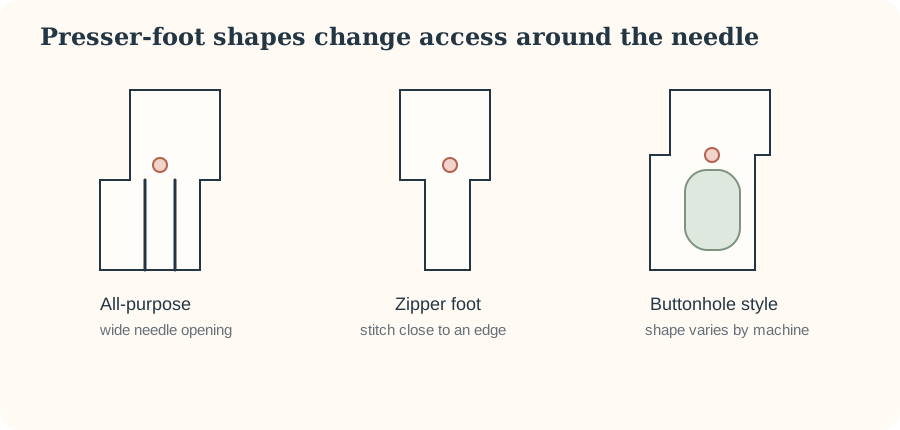
You do not need a drawer full of feet to begin sewing; understand the few that solve recurring tasks.
All-purpose or zigzag foot
This is the everyday foot on many machines. Its wider opening accommodates straight and zigzag stitches. Confirm the allowed needle positions so the needle cannot strike the foot.
Zipper foot
A zipper foot lets the needle stitch closer to zipper teeth or piping. Depending on the design it may attach on either side. Turn the handwheel manually after changing position to confirm clearance before sewing under power.
Buttonhole foot
Machines differ substantially here: some use a one-step sensor-style foot while others use multi-step controls. Follow your machine manual and test the complete buttonhole on scrap fabric with the same interfacing.
When a specialist foot is worthwhile
A specialist foot earns its place when it makes a repeated operation easier or more consistent. Buy for a known task rather than collecting accessories before you know what you sew.
Choose a presser foot by the operation
The standard or all-purpose foot handles many ordinary seams, but specialty feet make particular operations easier by changing visibility, guidance, clearance or how layers are fed. The useful question is not “how many feet should I own?” but “which repeated sewing task would a different foot solve?”
All-purpose / zigzag foot
This is the baseline foot on many machines and normally accommodates straight and zigzag stitches within its needle opening. Check the manual for the exact foot and permitted stitch/needle-position combinations.
Zipper foot
A zipper foot lets the needle stitch close to zipper teeth, piping or another raised edge. Depending on the machine it may attach on different sides or use adjustable positioning. Always verify needle clearance before sewing.
Buttonhole foot
Buttonhole systems vary considerably. Some machines use a foot that measures a button for an automatic one-step buttonhole; others use different controls. Follow the model manual rather than treating buttonhole feet as universal.
Quarter-inch and edge-guiding feet
These are useful when a consistent narrow seam is central to the work, particularly patchwork. A guide can improve repeatability, but the actual distance depends on needle position and foot design, so verify it with a ruler and test seam.
Walking/even-feed style feet
These are designed to help manage layers that tend to shift relative to one another. They can be useful for quilting and some difficult layered materials. Compatibility matters: attachment method, shank/adapter, needle clearance and manufacturer instructions all need checking.
Before buying any foot
Identify the exact machine model, read its accessory chart, determine whether the foot is snap-on or requires an adapter, and confirm supported stitch widths/needle positions. Turn the handwheel slowly after installation to make sure the needle will not strike the foot. “Low shank” or “universal” marketing language is not enough evidence by itself.